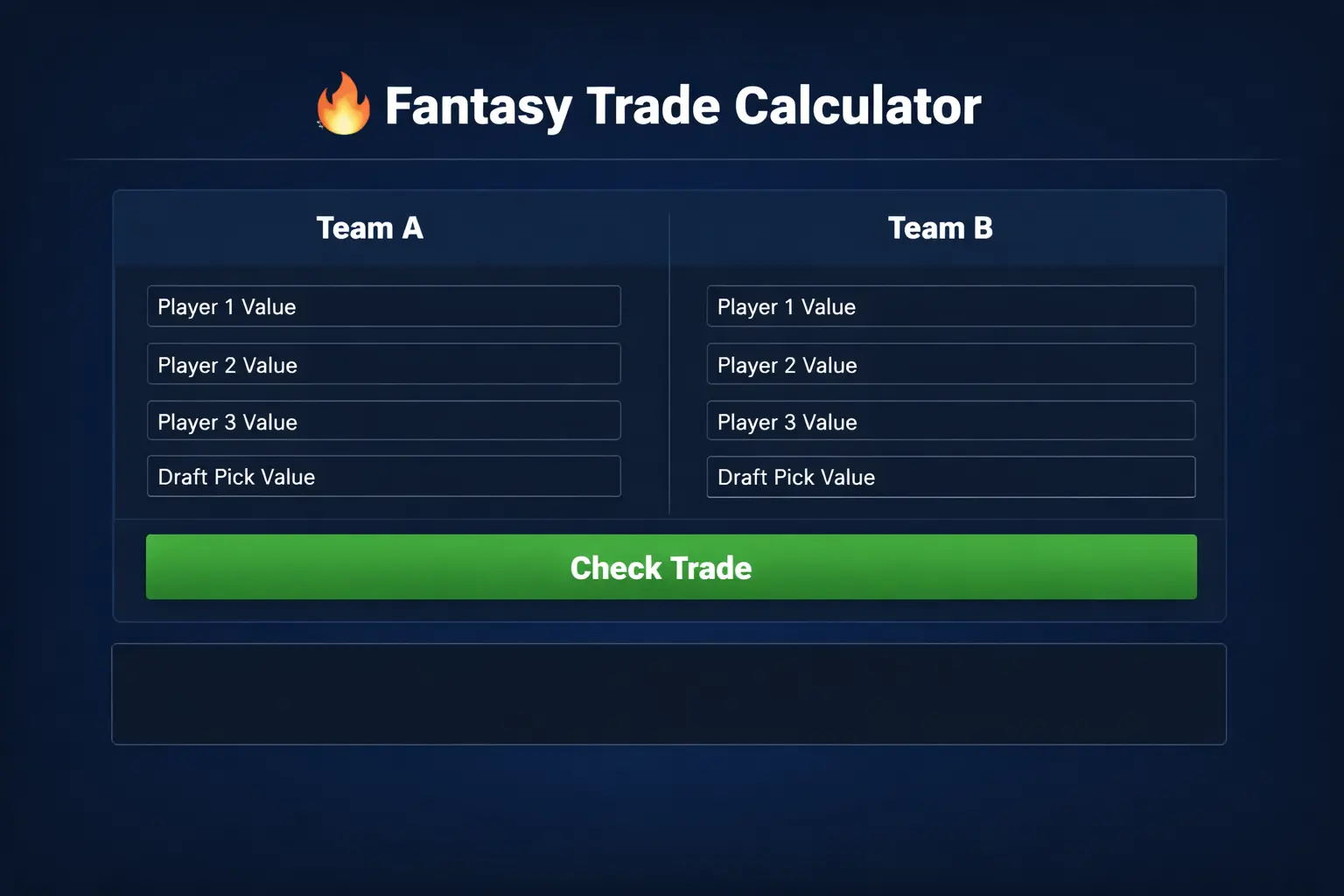
Every dynasty fantasy football manager has lived through this moment. You stare at a trade offer and wonder if a Dynasty Trade Calculator would tell you to smash accept or run away. A trade offer lands in your inbox, and your gut says yes — but your brain is screaming that you might be getting fleeced. Is that aging wide receiver and a second-round pick actually fair for your young running back? In redraft leagues you can afford a few mistakes. In dynasty, where you keep players for years, one bad trade can haunt your roster for half a decade. That is why trade calculators have become essential equipment for serious managers.
It is an online tool that assigns numerical values to players and draft picks, then compares the two sides of a proposed trade to tell you which side is getting more value. It removes emotion from the equation and replaces gut feelings with data. In this guide, I will break down the best trade calculator options for 2026, explain how to use them properly, and share the strategy insights that separate managers who win trades from managers who get taken advantage of.
Dynasty Trade Calculator: Why Dynasty Trades Need a Calculator

Dynasty fantasy football is a completely different game from redraft, and that difference is exactly why trade calculators matter so much more here. In a redraft league, you are valuing players for one season. A 30-year-old running back with one good year left can be worth as much as a 23-year-old with five good years ahead, because you only care about this year. In dynasty, age and long-term outlook change everything.
The core problem is that human brains are terrible at weighing multi-year value intuitively. When someone offers you two decent players for your one great player, it feels like you are getting more. But if your one great player will produce for five years and their two players will be irrelevant in two, you just lost the trade badly. A good calculator forces you to confront these time horizons with actual numbers instead of vibes.
Draft picks add another layer of complexity. A first-round rookie pick in dynasty is essentially a lottery ticket — it could become a superstar or a bust, and its expected value depends on the draft class strength, your pick’s likely position, and how your league values youth. Most managers wildly misprice picks, either overvaluing them because “anything could happen” or undervaluing them because they want proven players. Calculators apply consistent pick values based on historical hit rates, which grounds the conversation in reality.
There is also the psychology of negotiation. Trade talks are adversarial by nature, and both sides come in believing their players are worth more than they are. This is not dishonesty — it is just fandom and attachment. You watched your rookie break out; you are emotionally invested. A neutral calculator gives both sides a shared reference point. You might still disagree with the numbers, but at least you are arguing about the same numbers instead of talking past each other.
Finally, calculators protect you from yourself. The most dangerous trades are the ones you want to make emotionally — selling low on a struggling young player, buying high on a veteran after one big game, panic-trading after a bad week. Running the numbers before accepting adds a moment of calm reflection that has saved countless rosters from impulsive mistakes.
How Dynasty Trade Calculators Actually Work
Understanding what goes into these tools helps you use them intelligently instead of treating their output as gospel. No calculator is perfect, but knowing their methodology tells you when to trust the numbers and when to adjust.
Most calculators start with a player valuation system. The best ones use a combination of expert consensus rankings, statistical projections, and market data from real trades and ADP (average draft position). Each player gets a numerical value — say, 8,500 for an elite young receiver, 3,200 for a solid veteran starter, 800 for a bench lottery ticket. These values are updated regularly throughout the year as performance and situations change.
Age curves are baked into dynasty values in a way they are not for redraft. A 24-year-old and a 29-year-old might score similarly this season, but the dynasty calculator will value the younger player significantly higher because of expected future production. The exact shape of these age curves varies between calculators, which is one reason different tools sometimes disagree. Running backs fall off a cliff around age 28; wide receivers often produce into their early 30s; quarterbacks can play at a high level well past 35. Good calculators reflect these positional realities.
Draft pick valuation is the other major component. Calculators typically assign values to rookie picks based on historical outcomes — what a random first-round pick has actually been worth, on average, over the past decade. Some adjust for the perceived strength of the incoming rookie class. Most also handle future picks, usually discounting them slightly because a pick two years out carries more uncertainty than one this year.
When you input a trade, the calculator sums the values on each side and shows you the difference, often as both a raw number and a percentage. A trade within 5 to 10 percent is generally considered fair — close enough that team needs and preferences can justify either side. A 20 percent gap means someone is winning clearly. A 40 percent gap means someone did not run the numbers.
The key limitation to remember: calculators measure consensus market value, not value to your specific team. If you are rebuilding, a 27-year-old star is worth less to you than the calculator says. If you are contending, that same player is worth more. The calculator tells you what the market thinks; your job is to adjust for your situation. Never let a tool override your understanding of your own roster’s needs.
Best Dynasty Trade Calculator Tools for 2026
Not all calculators are created equal. The best ones update frequently, use transparent methodology, account for your league settings, and have earned the trust of the dynasty community over time. Here are the standouts.
Dynasty Trade Calculator: KeepTradeCut
KeepTradeCut is the people’s champion of dynasty valuation — a crowdsourced Dynasty Trade Calculator where thousands of managers rank players daily. Instead of relying on a handful of experts, it aggregates the collective wisdom of the community into dynamic player values. When a rookie has a breakout game, you can watch his value climb in real time as managers update their rankings.
The crowdsourced model is both the strength and the weakness. On one hand, it captures market sentiment faster than any expert panel — if the community is suddenly high on a player, the value reflects it immediately. On the other hand, crowds can be irrational, overreacting to single games and falling for hype trains. Smart managers use KeepTradeCut as a read on market value (what other managers think players are worth) rather than true value (what they will actually produce).
The trade calculator itself is clean and fast. Add players and picks to each side, and it instantly shows values, differences, and a visual breakdown. It supports superflex, tight end premium, and various scoring settings, which matters because player values shift significantly with format. The base version is free; premium adds features like league sync and advanced analytics.
Dynasty Trade Calculator: FantasyPros Dynasty Trade Value Chart
FantasyPros takes the expert consensus approach, aggregating rankings from dozens of fantasy analysts into composite values. Their Dynasty Trade Calculator benefits from this breadth — instead of one person’s opinion, you get the averaged judgment of the industry. The values tend to be more stable than crowdsourced alternatives, which some managers prefer.
The tool integrates with their broader ecosystem of rankings, projections, and draft tools, which is convenient if you already use FantasyPros for other research. You can import your league settings for customized values, and the trade analyzer considers positional scarcity in your specific format. The interface is polished and the data updates regularly during the season.
One advantage of the expert model is resistance to hype. When a little-known rookie has one big preseason game, the crowd might send his value to the moon while experts stay measured. If you find yourself constantly fading public hype, an expert-based calculator aligns better with your approach. The trade-off is slower reaction to genuine breakouts.
Dynasty Trade Calculator: Dynasty Nerds Trade Calculator
Dynasty Nerds has been serving the dynasty community for years with a calculator known for detailed, transparent valuations. Their values come with explanations — you can see why a player is ranked where he is, which helps you evaluate whether you agree with the underlying assumptions. This transparency is valuable for learning, not just for running numbers.
The site pairs its calculator with extensive dynasty content — rankings, rookie profiles, strategy articles — so you can research the “why” behind the values. Their trade calculator handles complex multi-player, multi-pick deals smoothly, and the values tend to reflect a thoughtful balance between analytics and film-based scouting opinion.
Dynasty Trade Calculator: PlayerProfiler Data-Driven Values
For the analytically inclined, PlayerProfiler offers valuations rooted in advanced metrics — college production, athletic testing, breakout age, dominator rating, and other predictive indicators. Their Dynasty Trade Calculator appeals to managers who trust data over narrative and want values grounded in measurable traits rather than expert opinion or crowd sentiment.
This approach shines for evaluating young players and rookies, where traditional scouting opinions vary wildly but the underlying metrics tell a consistent story. If a receiver dominated in college, broke out early, and tested as an elite athlete, the data says he is likely to succeed regardless of what any particular analyst thinks. For dynasty managers who build through youth, these data-driven values are gold.
How to Use a Dynasty Trade Calculator Like a Pro
Owning a hammer does not make you a carpenter. Here is how experienced dynasty managers actually use these tools to win trades rather than just evaluate them.
Always run the numbers before proposing, not just before accepting. Most managers only check the calculator when they receive an offer. The real edge comes from running it on trades you are thinking about proposing. If the calculator says your offer is 30 percent light, you know it will get rejected — adjust before sending and save yourself the insult. If it says you are overpaying by 20 percent, trim the offer. Proposing fair deals gets more trades accepted.
Use multiple calculators and look for consensus. If three different tools all say you are winning a trade by 15 percent, you are probably winning. If they disagree wildly, that disagreement itself is information — it means the players involved are hard to value, which means there is room for negotiation. Never rely on a single source, especially one you know favors your position.
Adjust for your league’s specific tendencies. Calculators reflect average market values, but your league is not average. If your league mates consistently overvalue draft picks, then picks are worth more in your league than the calculator says — which means you should be selling picks, not buying them. Track actual trades in your league for a season and you will start to see where your market deviates from consensus. Exploit those deviations.
Factor in roster construction, not just raw value. A calculator might say a trade is perfectly even, but if it leaves you starting a waiver-wire player at a position while your bench overflows at another, you lost. Always ask: does this trade improve my starting lineup? Does it fix a positional weakness? Does it align with my contention window? Value is necessary but not sufficient — fit matters.
Do not show your work in negotiations. Telling a league mate “the calculator says you are ripping me off” is a great way to kill a trade and annoy someone. Use the tool privately to inform your decisions, then negotiate like a human — talk about needs, preferences, and fit. The calculator is your advisor, not your spokesperson.

Dynasty Trade Calculator: Common Dynasty Trading Mistakes the Calculator Prevents
Even experienced managers fall into predictable traps. Here are the ones a Dynasty Trade Calculator most reliably catches.
Selling young players after a slow start is the classic dynasty blunder. A second-year receiver with elite metrics has three quiet games, his manager panics, and he gets traded for fifty cents on the dollar. The calculator does not panic — it still shows the player’s long-term value based on age, talent, and situation. When your emotions say “get rid of him,” the numbers remind you that nothing fundamental has changed.
Overpaying for veterans during a championship push is the mirror image. You are one piece away, so you trade two promising young players for a 30-year-old star. Sometimes this is correct — flags fly forever, as they say. But the calculator forces you to see the true cost. If you are giving up 12,000 in long-term value for 7,000 in win-now value, you should at least make that choice consciously rather than stumbling into it.
Mispricing rookie picks is nearly universal. Some managers treat every first-round pick like a guaranteed star; others treat them as throw-ins. Historical data says a mid-first-round rookie pick has roughly a 40 percent chance of becoming a reliable fantasy starter. The calculator prices picks at their expected value, which prevents both the “my first-rounder is untouchable” and the “sure, throw in your first” extremes.
Ignoring positional scarcity distorts valuations. In a 1QB league, the difference between QB5 and QB15 is smaller than the difference between RB5 and RB25. Calculators that account for your league settings capture this automatically. If yours does not, manually adjust — premium positions in your format deserve premium valuations.
Forgetting about contract and salary implications (in leagues that have them) is another blind spot. A player on a cheap long-term deal is worth more than the same player about to hit free agency. Most basic calculators do not handle contract leagues, so if yours does not, do the adjustment yourself before trusting the output.
Dynasty Trade Strategy Beyond the Numbers
The calculator handles valuation. Strategy handles everything else. Here is what separates good dynasty traders from great ones.
Buy low on talent, sell high on production. The most profitable dynasty trades exploit the gap between what a player is and what he just did. A talented player coming off a down year (due to injury, bad quarterback play, or coaching misuse) can often be acquired below his true value. A limited player coming off a career year can be sold above his. The calculator helps you identify these gaps — look for players whose value changed dramatically based on small samples.
Trade with rebuilding teams when you are contending, and vice versa. This sounds obvious, but many managers try to trade with everyone equally. A rebuilding team has no use for a 29-year-old star and every use for your 22-year-old prospect. A contender feels the opposite. These complementary needs create natural win-win trades where both sides genuinely improve. Target trade partners whose timeline is the opposite of yours.
Use the “two quarters for a dollar” principle carefully. Trading two good players for one great player often wins championships, because starting lineups matter more than bench depth. But the math has to work — two quarters are only worth a dollar if they are actually quarters. Do not trade two declining assets for one elite player and call it consolidation; that is just losing with extra steps. The calculator keeps you honest about whether your two quarters are really worth fifty cents each.
Be patient with the trade market. The best trades often come from waiting, not forcing. Put players on the trade block, mention you are open for business, and let offers come to you. Desperation is visible and expensive — the manager who “needs” to make a trade this week always overpays. Set your price based on the calculator, communicate it calmly, and wait for someone whose needs match your assets.
Keep a trade journal. Write down every significant trade you make or seriously consider, along with the calculator values at the time. Review it yearly. You will start to see patterns in your own behavior — positions you consistently overvalue, types of deals you regret, league mates who always get the better of you. This self-awareness compounds over seasons into a genuine trading edge that no calculator can provide.
When to Trust the Calculator and When to Override It
A Dynasty Trade Calculator is a tool, not an oracle. Knowing its limits is as important as knowing how to use it.
Trust the calculator for baseline fairness. If a trade is within 10 percent on multiple calculators, it is fair by market standards. This is useful for quickly evaluating offers and for proposing deals that will be taken seriously. Most of the time, market value is the right starting point.
Override it for your team’s specific situation. A rebuilding team should discount veterans; a contender should discount distant future picks. If your league has unique scoring, roster, or contract rules that the calculator does not fully model, adjust accordingly. The calculator does not know that you already have three tight ends or that your league starts two quarterbacks — you do.

Override it when you have genuine information advantages. If you have watched every snap of a player’s college career and the analytics support your read, your evaluation of that specific player might beat the consensus. Calculators are right on average; you can be right in specific cases where you have done deeper work. Just be honest with yourself about whether you actually have an edge or just a feeling.
Override it for the human element. Sometimes you make a slightly “losing” trade to build a relationship with a frequent trade partner, to consolidate a messy roster, or simply because you enjoy watching a particular player. Fantasy football is supposed to be fun. A calculator-optimal roster that you do not enjoy managing is worse than a slightly suboptimal one you love. Use the numbers as a guide, not a cage.
When you’re getting started with Dynasty Trade Calculator, the biggest mistake is trying to do everything at once. The people who get the best results from Dynasty Trade Calculator start small, focus on one specific goal, and build from there. Think of Dynasty Trade Calculator as a skill you develop over time, not a switch you flip. Each week you spend working with Dynasty Trade Calculator, you’ll notice patterns in what works and what doesn’t.
Not every approach to Dynasty Trade Calculator is right for every person. Your budget, your experience level, and your end goal all shape which Dynasty Trade Calculator strategy makes sense for you. Someone exploring Dynasty Trade Calculator for the first time needs different guidance than someone who’s been using Dynasty Trade Calculator for months. The advice below assumes you’re past the absolute basics but still figuring out the details.
When you’re getting started with Dynasty Trade Calculator, the biggest mistake is trying to do everything at once. The people who get the best results from Dynasty Trade Calculator start small, focus on one specific goal, and build from there. Think of Dynasty Trade Calculator as a skill you develop over time, not a switch you flip. Each week you spend working with Dynasty Trade Calculator, you’ll notice patterns in what works and what doesn’t.
Not every approach to Dynasty Trade Calculator is right for every person. Your budget, your experience level, and your end goal all shape which Dynasty Trade Calculator strategy makes sense for you. Someone exploring Dynasty Trade Calculator for the first time needs different guidance than someone who’s been using Dynasty Trade Calculator for months. The advice below assumes you’re past the absolute basics but still figuring out the details.
Frequently Asked Questions
How accurate are dynasty trade calculators?
They are accurate at measuring consensus market value, which is what most trades are actually negotiated around. They are less accurate at predicting true future production — no one can do that reliably. Think of these tools as a market price guide rather than a crystal ball. It tells you what players are worth in trades right now, not what they will score over the next five years.
Should I use the same calculator as my league mates?
It helps to know which one they use, because that shapes their perception of value. If your entire league uses KeepTradeCut, then KeepTradeCut values are effectively the market in your league regardless of what other tools say. You can still use other calculators for your own analysis, but understanding the dominant tool in your league gives you insight into how others will evaluate your offers.
How often should I check player values?
During the season, weekly is plenty — values shift with performance, injuries, and depth chart changes. In the offseason, monthly checks keep you current on the slow drift of dynasty value as players age, change teams, and as rookie classes get evaluated. Do not obsess over daily fluctuations; they are mostly noise. But do run the numbers fresh before any significant trade rather than relying on values you remember from a month ago.
Can a trade be fair if the calculator says it is lopsided?
Yes, when team-specific factors dominate. A rebuilding team trading an aging star for youth might “lose” on the calculator but win for their timeline. A contender overpaying slightly for the final piece of a championship roster is making a rational choice the calculator cannot see. Fairness in dynasty is about improving your team’s championship odds, not about winning the value calculation. The calculator measures one important dimension; your judgment covers the rest.
Winning dynasty trades consistently comes down to process: run the numbers with a good Dynasty Trade Calculator, adjust for your situation, understand your league’s market, and stay disciplined about value. Do that year after year, and the compound effect on your roster will be enormous. The managers who dominate dynasty leagues are not necessarily the best drafters — they are the ones who win the trade market, one well-calculated deal at a time.