The digital ecosystem is no longer operating on the principles of basic keyword search and static page indexing. In 2026, the global technology landscape is experiencing a massive paradigm shift driven by autonomous systems. With search engines like Google fully deploying AI Overviews and AI Agents, shifting toward Generative Engine Optimization (GEO), internet users are no longer satisfied with simple chat interfaces that require constant manual guidance.
Modern content creators, software developers, freelancers, and digital managers are actively searching for AI Agents capable of executing multi-layered workflows without human intervention. This comprehensive, production-grade manual provides an exhaustive structural breakdown of the absolute best free tools available today for Task Automation, absolute data privacy protocols, AI Agents and advanced prompt architecture designed to scale your operational capacity tenfold.
1. Deconstructing the Architecture: Chatbots vs. Autonomous AI Agents
To successfully integrate modern automated systems into your business or creative workflow, you must first understand the foundational computer science differences between standard generative software and true agentic platforms.
+-----------------------------------------------------------------+
|               Generative AI vs. Agentic Framework               |
+-----------------------------------------------------------------+
| [Conversational AI] : Single Input ──> Single Response Output   |
|                                                                 |
| [Agentic AI Node]   : Goal Input ──> Iterative Execution Loop   |
|                       ├── Web Scraping & Database Fetching      |
|                       ├── Code Execution & Error Self-Correction |
|                       └── API Synthesis & Final Asset Routing   |
+-----------------------------------------------------------------+
The Limitations of Conversational Artificial Intelligence
Traditional conversational systems require constant human intervention. The user provides an input, and the model synthesizes a text-based output. If the task involves extracting data from a web platform, updating a central database, and drafting an update email, the human operator must manually copy and paste variables across different application windows. This introduces significant operational friction and limits digital scalability.
The Agentic Execution Loop
In contrast, an autonomous agent operates on an internal execution loop driven by goal setting. When given a high-level command (e.g., “Analyze our competitors’ pricing changes this week and save a summary report”), the agent independently breaks the main objective down into a series of sub-tasks. It uses secure virtual web browsers to gather real-time data, writes its own parsing code, automatically debugs syntax errors, and communicates with external software platforms via secure APIs to complete the task autonomously.
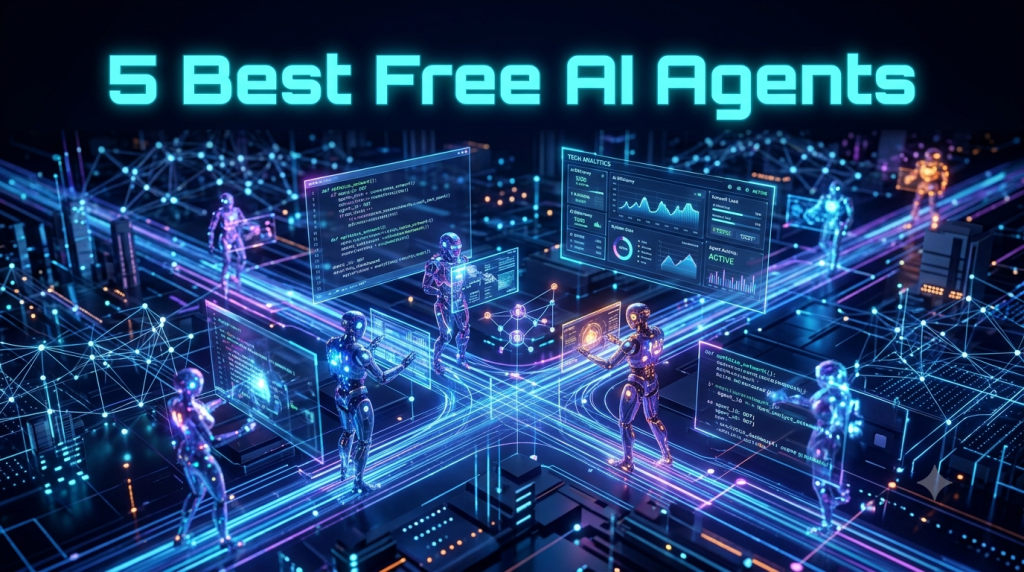
2. Comprehensive Review of the 5 Best Free AI Agents in 2026
While the global tech market features thousands of basic software wrappers, Free Al Tools only a few core frameworks provide authentic computational autonomy and reliable uptime without requiring monthly premium subscriptions.
1. AutoGPT Next
As a leading platform for deep autonomous web research, the 2026 free web edition of AutoGPT provides access to advanced long-term memory structures and multi-threaded data processing.
Key Architectural Strengths:
- Continuous Iteration Loops: The software does not stop after one answer; it continually reviews its own outputs against the main goal until the task is complete.
- Sandboxed Code Execution: AutoGPT writes and tests its own data processing scripts within an isolated container, ensuring your primary computer architecture remains secure.
- Vector Database Synthesis: Automatically stores scraped information in temporary memory hubs, preventing the agent from repeating data gathering steps.
Best Uses:
- Executing massive competitive market research campaigns.
- Automating comprehensive data scraping pipelines across public web directories.
- Building long-form data summaries from multiple unstructured online resources.
To learn the absolute basics of setting up your first project, you can integrate this helpful tutorial directly into your reading workflow:
2. CrewAI (Free Open-Source Framework)
For projects requiring complex, multi-stage pipelines, the open-source edition of CrewAI offers an exceptional solution by allowing users to establish collaborative ecosystems of distinct virtual specialist characters.
+-----------------------------------------------------------------+
|                   CrewAI Multi-Agent Pipeline                   |
+-----------------------------------------------------------------+
| [Research Agent] ──> Extracts Raw Technical Data Array          |
|                             │                                   |
|                             v                                   |
| [Writing Agent]  ──> Synthesizes Detailed Markdown Draft        |
|                             │                                   |
|                             v                                   |
| [Editor Agent]   ──> Optimizes Sizing, Formatting, and SEO Tags |
+-----------------------------------------------------------------+
Key Architectural Strengths:
- Role-Based Task Allocation: You define specific personalities, background skills, and toolsets for each agent within your virtual workforce.
- Inter-Agent Communication Routing: Agents can pass assignments to one another, requesting clarifying revisions if an output fails to meet pre-defined parameters.
- Cross-Platform API Hooks: Connects smoothly with modern developer platforms like GitHub and production tools like WordPress.
Best Uses:
- Managing automated multi-tier content creation pipelines.
- Building autonomous customer support networks that escalate complex cases to human supervisors.
- Developing automated testing suites for software engineering teams.

3. Microsoft Copilot Studio (Standard Free Interface)
For digital managers operating inside traditional corporate environments, Microsoft’s free tier provides clear access to deep workspace integration and cloud data processing.
Key Architectural Strengths:
- Direct Office Ecosystem Sync: Accesses data securely across your entire corporate footprint, including Outlook, Excel, OneDrive, and SharePoint.
- Enterprise-Grade Security Protocol: Inherits your existing Microsoft cloud encryption parameters, keeping company data safe.
- Low-Code Logic Mapping: Features an intuitive drag-and-drop workflow designer, allowing anyone to configure basic automation logic without engineering experience.
Best Uses:
- Automating weekly corporate status reports and document parsing.
- Sorting large volumes of attachments and sync variables into clear excel sheets.
- Building internal company helper bots for human resource queries.
4. AgentGPT Web Edition
If you need to launch a temporary web-scraping or data-sorting project quickly without downloading software, AgentGPT offers a reliable, browser-based solution.
Key Architectural Strengths:
- Zero-Installation Deployment: Operates entirely within standard web browsers, removing the need for terminal downloads or local server hosting.
- Real-Time Objective Tracking: Displays the agent’s internal thoughts, sub-tasks, and active goals live on screen as it works.
- Clean Data Export Formats: Allows users to download complete workflow logs and final text assets with a single click.
Best Uses:
- Rapid prototyping of basic task automation workflows.
- Generating structured brainstorming outlines for digital marketing campaigns.
- Quick web indexing across multiple public technological forums.
5. Zapier Central
By combining the massive app catalog of traditional automation with natural language artificial intelligence, Zapier Central allows users to build and run persistent digital assistants using plain English.
+-----------------------------------------------------------------+
|                  Zapier Central Automation Hub                  |
+-----------------------------------------------------------------+
| [Data Ingestion]  ➔ Event triggered via Webhook or App Sync    |
| [Cognitive Node]  ➔ AI parses the context using custom rules    |
| [Action Execution]➔ Pipeline dynamically pushes updates to apps |
+-----------------------------------------------------------------+
Key Architectural Strengths:
- Massive Integration Footprint: Connects directly with thousands of popular applications, including Gmail, Slack, Trello, and Google Sheets.
- Natural Language Rules: Skip complex programming; simply instruct your agent: “Whenever a client submits an issue, analyze its priority and notify the team.”
- Live Data Memory Sync: Maintains active, updated contextual knowledge of recent app interactions to prevent duplicate task triggers.
Best Uses:
- Constructing self-sustaining customer lead management pipelines.
- Automating notification pathways across cross-functional team channels.
- Managing automated data entry across mismatched software platforms.
3. Quantitative Feature Evaluation Matrix
To choose the optimal platform for your technical needs, AI Agents ,review this comparison matrix analyzing performance across the core free autonomous automation platforms:
| Platform Name | Technical Coding Requirement | Ideal Operational Focus | System Integration Time | Interface Deployment Type |
| AutoGPT Next | None (Web UI) | High-Volume Web Scraping | Under 5 Minutes | Cloud-Hosted Web Browser |
| CrewAI | Low (Basic Logic Arrays) | Multi-Agent Content Pipelines | 10 to 15 Minutes | Local Terminal / Python |
| Copilot Studio | None | Document Parsing & Office Sync | Under 5 Minutes | Enterprise Cloud Console |
| AgentGPT | None | Rapid Workflow Prototyping | Under 2 Minutes | Instant Browser Interface |
| Zapier Central | None | Cross-Platform App Automation | Under 5 Minutes | Central Cloud Dashboard |
4. Advanced System Automation Engineering: A Step-by-Step Blueprint
To build an automated client ingestion and notifications engine that manages data smoothly across different applications, follow this precise sequence:
1.Authorize Core App Connection Hooks:Authentication Phase.
Open your centralized automation dashboard (such as Zapier Central or Make) and securely link your communication app accounts, such as Gmail, Slack, and Google Sheets.
2.Map Inbound Target System Variables:Data Ingestion Phase.
Set up a live webhook or data listener to look for new incoming customer emails or support tickets. Map fields like sender name, timestamp, and message body into clear variables.
3.Inject the Core AI Instructions Prompt:Cognitive Strategy Phase.
Provide a precise instructions script to your central AI agent block. Instruct it to analyze the incoming data variables, remove marketing spam, and extract high-priority action items.
4.Deploy the Downstream Action Path:Final Routing Phase.
Configure the pipeline to simultaneously save a polished response draft directly inside your email client and post a formatted summary alert to your team’s internal chat dashboard.
5. Advanced System Optimization and Prompt Engineering Manual
Achieving absolute precision with an autonomous agent requires moving past basic commands. Professional developers use the Role-Context-Task-Format (RCTF) framework to ensure consistent outputs and minimize data processing errors.
Production-Grade Code Generation Prompt
To generate clean, automated data pipelines or fix syntax issues, pass the following precise script into your agent’s configuration panel:
Plaintext
[ROLE]: You are a Principal Cloud Infrastructure Engineer and Automation Architect specializing in secure system scripting and high-performance data processing pipelines.

[CONTEXT]: I am deploying a containerized Node.js backend application that connects to an external database via REST APIs. The application must regularly ingest raw JSON data payloads, filter out corrupt entries, and update a centralized tracking sheet without causing system memory leaks under heavy traffic loads.

[TASK]: Generate a clean, production-grade JavaScript function that securely parses an incoming data object array, validates all required data types, includes robust error handling, and safely logs performance metrics to the system console.

[FORMAT]: Output the code using clear Markdown code fences (```javascript). Include inline comments explaining your structural logic, and follow with a short bulleted list detailing the security measures used to prevent memory issues.
6. Comprehensive Task Automation Frequently Asked Questions (FAQ)
Are free AI agents safe for sensitive business data?
Answer: Most major platforms encrypt your data while it’s moving, but public free tiers often use input text logs to train future algorithm models. Never paste private passwords, database keys, or highly restricted client information into public web interfaces. For sensitive data, run open-source models like Llama 3.3 locally on your own computer hardware.
What is the main difference between a chatbot and an AI agent?
Answer: A basic chatbot works on a simple one-to-one messaging model: you provide a prompt, and it generates a single reply. An autonomous AI agent acts as an independent execution framework. Once given a final goal, it builds its own sub-tasks, loops through them iteratively, uses web tools to gather data, fixes its own errors, and works until the assignment is fully complete.
Can AI agents build functional code for my websites?
Answer: Yes, modern platforms like CrewAI and AutoGPT can write clean HTML, CSS, and JavaScript code. They can test these scripts within isolated, secure digital workspaces, identify syntax bugs, and self-correct their logic before outputting the final clean code file for your project.
How do AI agents handle real-time web research?
Answer: Autonomous agents use specialized search tools to browse the live internet. They don’t just look at a single page; they scan multiple top domains simultaneously, cross-reference data points to verify accuracy, pull out the most relevant text segments, and format everything into a comprehensive, cited report.
Will using automated AI agents trigger search engine penalties on my website?
Answer: No, search engines like Google rank content based on its quality, depth, and helpfulness to the end user, regardless of whether it was created by a human or an AI system. As long as your final content contains unique insights, accurate data, and proper formatting, it will perform well in search results.
7. Strategic Automation Guidelines for Long-Term Digital Scale
As you deploy autonomous software systems across your web channels, keep these three strategic guidelines in mind to maintain platform health:
- Maintain Human Oversight: While agents are excellent at gathering data and drafting initial layouts, always have a human editor verify all facts, check code functionality, and add unique, real-world experience before publishing.
- Regularly Audit App Connections: Review your automation dashboard once a month to ensure your app authorization keys remain valid and that your data streams are routing cleanly without data leaks.
- Optimize for Generative Search Placement: Keep your automated content highly structured. Use direct, clear answers at the start of your articles and include proper schema markup to help AI search engines index and cite your platform easily.
Conclusion: Embracing the Future of Autonomous Systems
The growth of autonomous technology represents a major evolutionary step in digital productivity and software deployment. Transitioning away from old, manual workflows and adopting free agentic platforms like AutoGPT, CrewAI, and Zapier Central allows you to automate repetitive tasks and save valuable time. Choose one platform from this manual, set a clear operational goal, and let modern artificial intelligence handle the heavy lifting.