The operational cadence of the global consumer electronics market has historically been anchored by predictable, highly synchronized annual launch windows. For over a decade, major hardware developers, most notably Apple, relied on single, high-impact autumnal showcase events to introduce their entire flagship smartphone portfolios to the market. This commercial model concentrated marketing resources, production ramps, and consumer spending into the final calendar quarter, establishing a reliable rhythm for component suppliers, logistics networks, and retail channels.
However, emerging macroeconomic pressures, physical limits in semiconductor scaling, and changing consumer buying habits are challenging this established model. Market projections surrounding the upcoming iphone 18 release date suggest that Apple is planning a significant shift, signaling a move toward a more flexible, staggered release cycle. Among consumer queries, the question of when is iphone 18 release date reflects a growing confusion regarding Apple’s shifting annual timelines, which now diverge significantly from the traditional mid-September standard.
This strategic transition is driven by a complex mix of supply chain realities, manufacturing cost-efficiency goals, and product tiering strategies. By moving away from simultaneous, multi-device rollouts, the hardware manufacturer can better manage yield rates for cutting-edge silicon, insulate itself from localized component shortages, and maximize the commercial lifecycle of existing products. This analysis evaluates the technical, strategic, and logistical variables shaping the upcoming hardware generation, offering professional peers an exhaustive overview of the next-generation mobile ecosystem.
Table of Contents
Deciphering the Split-Launch Strategy: The Dual-Phase iPhone 18 Release Date
Rather than launching four highly standardized models simultaneously, supply chain intelligence indicates a clear split in Apple’s product release strategy. The product rollout will be divided into two distinct phases, separating premium flagship hardware from mass-market devices.
| Launch Phase | Anticipated Timeline | Product Target | Core Engineering Highlights |
| Phase I (Autumn) | September 2026 | iPhone 18 Pro, iPhone 18 Pro Max, iPhone Fold (Ultra) | TSMC 2nm N2 Node, GAA-FETs, WMCM Packaging, Variable Aperture Optics, C2 baseband |
| Phase II (Spring) | March 2027 | Standard iPhone 18, iPhone 18e, iPhone Air 2 | Binned A20 Silicon, Component Commonality, Optimized Bill-of-Materials |
Analyzing the factors dictating the scheduled iphone 18 release date reveals a dual-phase roadmap designed to maximize initial profit margins. In Phase I, scheduled for September 2026, the company will focus entirely on its highest-margin devices: the Pro, Pro Max, and a new book-style folding model. This allows the manufacturer to capture early premium demand and focus initial assembly capacity on complex, high-value components.
Phase II, scheduled for March 2027, will introduce the standard models, the entry-level 18e, and a refined second-generation ultra-thin model. This delay is not merely a logistical side effect; it is a deliberate commercial tactic. By separating these launches by six months, the manufacturer maintains consumer interest year-round, easing the typical post-holiday drop in demand and stabilizing supplier production schedules throughout the fiscal year.
Supply Chain Demands, Memory Constriction, and the Delayed Standard Lineup
The decision to delay the standard tier until early 2027 is closely tied to supply chain management and component procurement realities. Furthermore, the timing of the iphone 18 release date is heavily influenced by a global deficit in DRAM production, which has restricted the availability of high-speed LPDDR5/LPDDR5X memory chips.
The Constraints of Global Memory Deficits
As on-device artificial intelligence engines require increasingly large localized memory reserves, Apple has standardized its flagship line at a minimum of 12GB of RAM. This memory requirement allows the device to load large language model weights directly into the system’s volatile memory.
To scale memory capacity across tens of millions of devices simultaneously during a global shortage would drive up production costs. Staggering the release allows memory suppliers to scale up their production lines, preventing supply shortages and shielding Apple’s gross margins from sudden component price spikes.
Strategic Market Preservation and Year-End Retail Events
By delaying the standard model, Apple can keep the previous iPhone 17 in high-volume production for a longer period. This is particularly advantageous in East Asian markets, where major retail events like China’s Double 11 (Singles’ Day) shopping festival drive massive sales volume.
By supplying domestic channels with mature, highly optimized previous-generation devices, Apple can maintain competitive pricing and secure market share without needing to heavily discount brand-new hardware. The longer production cycle for the older models lowers per-unit manufacturing costs, boosting profitability during key year-end sales.
Traditional Synchronous Release Model
|
(High Peak Demand & Supplier Strain)
========================================================================
New Staggered Release Model (Phase I & II)
| |
(Capture Premium Margin) (Steady Volume & Yield Recover)
Component Convergence at the Engineering Level
During the delay, Apple’s engineering teams are running concurrent Engineering Validation Testing (EVT) for both the standard model and the entry-level 18e. This parallel development allows for significant part sharing between the standard and budget-friendly devices.
Components like structural sub-frames, mid-plate castings, and logic board designs are being standardized across both models. This engineering alignment allows Apple to negotiate bulk pricing on materials, simplify factory re-tooling, and ensure high yield rates before mass production begins in early 2027.
Under the Hood: Next-Generation A20 Pro Silicon and the 2nm GAA Transition
As September approaches, anticipation regarding the iphone 18 release date centers on the silicon improvements powering the Pro tier. These premium models will debut the A20 Pro processor, built on TSMC’s 2-nanometer (N2) lithography. This transition marks a fundamental shift away from traditional FinFET architectures to advanced nanosheet transistor designs.
The Physics of Nanosheet/Gate-All-Around Transistors
In standard FinFET designs, the gate channel is surrounded on three sides by the gate electrode. As gate lengths shrink below 3nm, quantum tunneling and subthreshold leakage currents degrade power efficiency and heat dissipation.
To solve these physical limitations, the 2nm N2 node uses Gate-All-Around (GAA) nanosheets. Here, the channel is constructed of horizontal, stacked silicon wires completely enclosed by the gate dielectric and electrode. This design offers several key advantages:
- Electrostatic Control: Restores control over the channel, minimizing subthreshold leakage currents.
- Drive Current: Maximizes drive current per unit area, boosting performance.
- Flexible Channels: Allows engineers to adjust nanosheet widths to optimize performance versus power draw on a per-cell level.
To understand the energy improvements, the dynamic power consumption () of a complementary metal-oxide-semiconductor (CMOS) circuit is determined by the equation:
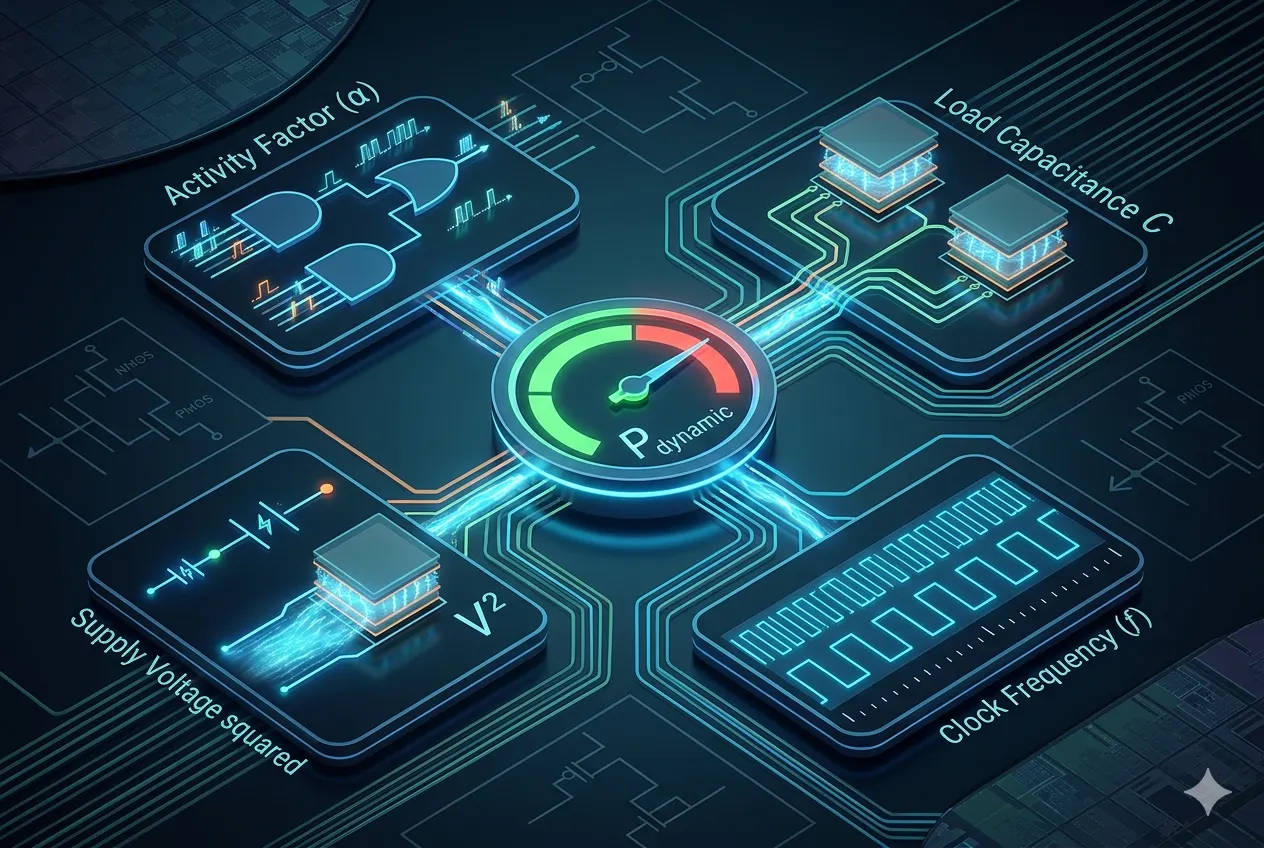
The dynamic power consumption ($P_{dynamic}$) of a complementary metal-oxide-semiconductor (CMOS) circuit is a key factor in its overall energy efficiency, representing the power consumed specifically when the circuit’s logic states are switching. This occurs as internal capacitances are charged or discharged.
The fundamental equation governing this dynamic power is:
$$P_{dynamic} = \alpha \cdot C \cdot V^2 \cdot f$$
Let’s explore each variable in detail:
- $\alpha$ (Switching Activity Factor): This factor, represented by the Greek letter alpha, indicates the probability that a given node or logic gate will transition from one state to another (e.g., from logic 0 to 1) during a clock cycle. It is a value between 0 (never switches) and 1 (switches every cycle). Circuits with complex logic or high data switching rates will have higher $\alpha$ values, leading to greater dynamic power dissipation. Designing for low switching activity is one approach to improving energy efficiency.
- $C$ (Load Capacitance): This variable represents the total parasitic capacitance of the output node driven by a specific logic gate. It includes the intrinsic capacitance of the driving transistors, the capacitance of the interconnecting wires, and the input capacitances of all the following logic gates (the load). A higher load capacitance means more charge must be moved for every state change, requiring more energy. Minimizing capacitance through shorter interconnects or smaller transistors is a powerful way to reduce power.
- $V$ (Supply Voltage): This is the voltage applied to power the circuit. Notice that the dynamic power depends on the square of the voltage ($V^2$). This quadratic relationship makes voltage scaling one of the most effective techniques for energy improvement. Even a relatively small reduction in the supply voltage can yield significant reductions in dynamic power, although this often comes at the cost of reduced circuit speed (frequency).
- $f$ (Clock Frequency): This is the operating frequency of the circuit, measured in Hertz (Hz) or cycles per second. Since charging and discharging occurs with each state change, dynamic power consumption is directly proportional to the frequency. Running a processor at a higher clock speed increases its dynamic power linearly, which is a major design consideration, especially in battery-powered devices.
Energy Improvements in Context
By examining the components of this equation, you can see several key strategies for improving energy efficiency in CMOS circuits:
- Voltage Scaling: Reducing $V$ offers the largest power savings due to the $V^2$ dependence, but must be balanced against performance requirements.
- Capacitance Reduction: Shorter wires, smaller transistors, and optimized routing help decrease $C$.
- Frequency Scaling: Operating at lower $f$ when high performance is not needed (dynamic voltage and frequency scaling, or DVFS) directly reduces power.
- Activity Optimization: Designing logic to minimize unnecessary switching and clock gating (disabling clock signals to unused blocks) helps reduce $\alpha$.
Each of these factors must be carefully considered and optimized to meet specific power and performance goals in modern integrated circuit design.
Where:
represents the physical gate capacitance of the interconnects.
is the switching frequency.
By using GAA nanosheets, TSMC’s N2 node reduces the gate capacitance () and allows the circuit to run at a lower operating voltage while maintaining high clock speeds. This design achieves a projected 15% increase in performance at equivalent power envelopes, or up to a 30% reduction in power consumption under active workloads compared to previous 3nm designs.
Wafer-Level Multi-Chip Module (WMCM) Packaging
The A20 Pro chip also introduces Wafer-Level Multi-Chip Module (WMCM) packaging. Traditional designs use Package-on-Package (PoP) layout systems where the DRAM is stacked on top of the main logic die, separated by an organic substrate.
WMCM integrates the logic die, graphics processing units, Neural Engine, and LPDDR5X RAM directly on a single wafer before dicing. By eliminating intermediate interposers, the physical distance between memory and the processor is reduced to micrometers.
This design provides several distinct benefits:
- Lower Signal Resistance: Reduces signal degradation and power consumption during high-speed data transfers.
- Thermal Efficiency: Simplifies heat dissipation, preventing local hotspots and thermal throttling.
- AI Bandwidth: The unified silicon layout is ideal for local AI tasks, allowing the Neural Engine to quickly load model weights for natural language processing.
Physical Architecture, Display Upgrades, and Design Aesthetics
While the internal processor handles performance, several visible design changes refine the look and feel of the Pro models.
Advanced LTPO+ Display Technology
The Pro models will feature 6.3-inch and 6.9-inch screens, using advanced LTPO+ OLED panels supplied by Samsung Display and LG Display. These updated panels offer several notable improvements:
- Response Times: Refined backplane configurations enable faster refresh rate adjustments.
- Efficiency: Lower energy consumption during static image display.
- Burn-In Protection: Upgraded organic compounds reduce the risk of pixel burn-in over time.
- Bezels: Thinner bezels maximize active screen space while keeping the overall device footprint identical to the previous generation.
You can also read our Best Free Video Editing Software 2026.
Shrunk Dynamic Island Cutout
Early rumors of completely under-display Face ID have been dismissed as premature due to light transmission challenges through active OLED pixels. Instead, Apple will shrink the Dynamic Island cutout.
By moving the Face ID flood illuminator beneath the active OLED screen, the physical width of the display cutout will shrink by roughly 35%, down from 20.7mm to 13.5mm. This adjustment cleans up the top status bar and gives users more usable screen space.
Prior Generation Dynamic Island Narrowed Dynamic Island
+——————–+ +——————–+
| [======] | | [====] |
+——————–+ +——————–+
Width: 20.7mm Width: 13.5mm
Premium Materials and Unified Finishes
The Pro models will feature an anodized aluminum frame, maintaining a premium feel while addressing structural durability. To address the mixed feedback on the two-tone rear of previous models, Apple will use a revised manufacturing process that blends the aluminum frame and rear glass for a more unified, seamless look.
According to industry leaks, Apple is testing several Pantone-coded colors for the Phase I launch:
- Dark Cherry (Pantone 6076): A deep wine-red with subtle burgundy and purple undertones, acting as the signature color for the generation.
- Light Blue (Pantone 2121): A soft blue reminiscent of Mist Blue.
- Dark Gray (Pantone 426C): A rich, charcoal option.
- Silver (Pantone 427C): A clean, classic metallic choice.
Revolutionary Camera Hardware: Variable Aperture and Stacked Sensors
For the ultra-premium Pro Max tier, the scheduled iphone 18 release date brings unprecedented physical camera upgrades designed to appeal to professional photographers. A primary focal point for power users is the scheduled iphone 18 pro max release date, which corresponds with the premium rollout.
The main 48-megapixel camera on both Pro models will feature a physical variable aperture system. Unlike standard smartphone cameras with fixed apertures (typically f/1.78), this system uses adjustable physical blades to control the size of the lens opening.
Creative and Technical Benefits of Variable Aperture
This mechanical camera system offers several key benefits:
- Natural Depth-of-Field: Photographers can choose a wide aperture (e.g., f/1.4) for a shallow depth-of-field and soft background blur, or a narrow aperture (e.g., f/4.0) to keep both foreground and background subjects in sharp focus.
- Exposure Balance: In bright outdoor settings, a narrower aperture prevents overexposure, allowing the camera to maintain optimal shutter speeds without needing software adjustments.
- Diffraction Control: Minimizes soft edges and aberration, delivering cleaner detail across the entire frame.
This mechanical assembly is complex. The lens assembly is estimated to cost Apple 50% more than previous seven-element plastic lenses. Sunny Optical is projected to supply 40% to 50% of these variable lens orders.
f/1.4 (Max Light / Shallow DoF) f/4.0 (Min Light / Deep DoF)
\ | / \ | /
— ( ) — —•—
/ | \ / | \
Samsung 3-Layer Stacked Image Sensors
At least one Pro model will feature a three-layer stacked image sensor supplied by Samsung. Traditional sensors place the photodiode and transistor circuitry on the same layer, which limits light collection area.
A stacked design separates these components into individual layers:
- Top Layer: Photodiodes optimized for maximum light gathering.
- Middle Layer: Control transistors that speed up readout times.
- Bottom Layer: Dedicated processing logic that reduces noise and improves dynamic range.
This physical camera upgrade is supported by custom software in iOS 27, including new Siri visual intelligence capabilities in the Camera app and advanced, AI-driven image editing tools.
Interaction and Connectivity: Camera Control 2.0 and In-House C2 Silicon
The autumn launch also brings refinements to user interaction and wireless connectivity across the Pro models.
Camera Control 2.0: Simplifying the User Interface
The touch-sensitive camera button introduced on the iPhone 16 has received mixed feedback for being overly sensitive and complicated. In response, Apple will simplify this button for the new lineup.
The updated design removes capacitive touch sensitivity, turning it into a dedicated pressure-sensitive button. This change reduces production costs, improves long-term mechanical reliability, and provides a more straightforward user experience.
The Custom C2 Cellular Modem and Location Privacy
Apple is continuing to transition away from Qualcomm cellular modems, introducing its in-house C2 modem in the upcoming Pro models. The C2 modem delivers robust 5G performance, including mmWave support, while offering lower power consumption than previous designs.
Crucially, the C2 modem introduces a new privacy feature: baseband-level “Limit Precise Location”. This setting intercepts location requests directly at the cellular modem level, preventing carrier networks from tracking precise coordinate data and sharing only a general neighborhood location instead.
Additionally, the modem supports the latest NR-NTN (New Radio Non-Terrestrial Network) standards. This standard enables direct satellite connectivity, allowing system apps to download map data, route navigation, and exchange messages even when users are completely off the cellular grid.
The Flexible Display Frontier: Analyzing the Folding Model (iPhone Fold / Ultra)
The integration of foldable displays directly impacts the broader iphone 18 release date window, introducing complex assembly challenges that influence Apple’s dual-phase rollout. The first foldable iPhone, likely named the iPhone Fold or iPhone Ultra, represents a major new entry in the premium smartphone segment.
Closed Profile (Double-Sided) Opened Flat Panel
+—+—+ +——-+——-+
| | | | | |
| 5.5″ | =====[ 180° Hinge Motion ]=====> | 7.8″ |
| Cover | | Flexible OLED|
| | | | | |
+—+—+ +——-+——-+
Thickness: 9.2mm Thickness: 4.5mm
Mechanical Hinge Design and the Invisible Crease
The iPhone Fold features a book-style horizontal design. The external cover display measures 5.5 inches, while the internal flexible OLED panel opens to a 7.8-inch display with a 4:3 aspect ratio.
To address the visible creases seen on rival foldables, Apple has developed a custom hinge and a new material property for the flexible display cover. This design allows the screen to bend without forming a sharp crease. While this custom hinge is expensive, recent supply chain reports suggest Apple has managed to reduce the component cost to around $70–$80, down from early $120 estimates.
Physical Profile and Biometric Authentication
To reach this goal, Apple has focused heavily on reducing the device’s thickness. The folding model measures just 4.5mm when unfolded and between 9.2mm and 9.5mm when closed, making it one of the thinnest foldables on the market.
Because Face ID is difficult to integrate across both open and closed states, the foldable model will feature a side-mounted Touch ID sensor in the power button, similar to current iPad designs.
Internal Specs and Launch Availability
The folding model will be powered by the 2nm A20 Pro processor and standardizes at 12GB of LPDDR5X RAM to support complex, on-device AI tasks. The device will offer three storage tiers: 256GB, 512GB, and 1TB.
Due to the complexity of the flexible display assembly, launch supply is expected to be highly constrained, which may lead to shipping delays shortly after announcement.
Standard Tier Product Differentiation: iPhone 18, 18e, and Air 2
By deferring the standard iphone 18 release date to early 2027, Apple can keep production lines running smoothly and control manufacturing costs. The standard lineup is designed to prioritize value, utilizing several component modifications to manage pricing.
Processor and Component Binning
Unlike the Pro models, the standard tier will feature a binned version of the A20 processor. While built on the same architecture, these binned processors will feature fewer active GPU cores (typically four working GPU cores compared to the five on the Pro tier).
This sorting process allows Apple to use chips with minor core irregularities that would otherwise be discarded, improving manufacturing yield rates and lowering average production costs.
Standardized Memory and Display Adjustments
To support core Apple Intelligence features, the standard model will be upgraded to 12GB of RAM. However, the display specifications will see minor regressions.
The standard model will use a simplified, binned OLED screen shared with the entry-level 18e, rather than the high-efficiency LTPO+ panels of the Pro line. These adjustments lower production costs while ensuring a reliable, high-quality user experience.
Component Tiering across the Lineup
<——-(Component Clones)——->
| |
(Binned Displays) (Binned Displays)
(4-Core GPU A20) (4-Core GPU A20)
\ /
+——–(Shared Assembly Lines/Lower Cost)——-+
Pushing the Second-Generation Ultra-Thin Model
The first-generation ultra-thin model released alongside the iPhone 17 saw lower than expected sales. In response, Apple is pushing the second-generation ultra-thin model to the Spring 2027 launch window.
To justify its $999 price point, engineering teams are adding a secondary camera to the slim chassis, addressing a key criticism of the original single-camera design.
Pricing Structures and Comparative Market Matrix
Despite rising component costs, Apple is expected to deploy an aggressive pricing strategy to pressure its Android competitors. The table below outlines projected global pricing and launch timelines across the upcoming generation.
| Product Model | Storage Tier | Projected US Price | Projected India Price | Projected Release Window |
| iPhone 18e | 256 GB | $699 | ₹79,000 | March 2027 |
| iPhone 18 (Standard) | 256 GB | $799 | ₹89,000 | March 2027 |
| iPhone Air 2 | 256 GB | $999 | ₹1,09,000 | March 2027 |
| iPhone 18 Pro | 256 GB | $1,099 | ₹1,35,000 | September 2026 |
| iPhone 18 Pro Max | 256 GB | $1,199 | ₹1,45,000 | September 2026 |
| iPhone Fold / Ultra | 256 GB | $1,999 | ₹1,65,000 | September 2026 |
| iPhone Fold / Ultra | 512 GB | $2,199 | ₹1,85,000 | September 2026 |
| iPhone Fold / Ultra | 1 TB | $2,399 | ₹2,05,000 | September 2026 |
Historical Analysis of the iPhone Lifecycle Cadence
To understand the scope of the upcoming split-launch strategy, the table below charts the historical progression of iPhone release cadences, showing the gradual transition toward staggered rollouts.
| Generation | iPhone Model | Announcement Date | US Release Date | Launch Style and Major Shifts |
| Gen 1 | Original iPhone | January 9, 2007 | June 29, 2007 | Summer launch, multi-touch debut |
| Gen 2 | iPhone 3G | June 9, 2008 | July 11, 2008 | Summer launch, App Store debut |
| Gen 3 | iPhone 3GS | June 8, 2009 | June 19, 2009 | Summer launch, camera upgrade |
| Gen 4 | iPhone 4 | June 7, 2010 | June 24, 2010 | Summer launch, FaceTime, Retina panel |
| Gen 5 | iPhone 4S | October 4, 2011 | October 14, 2011 | Shift to Autumn release, Siri debut |
| Gen 6 | iPhone 5 | September 12, 2012 | September 21, 2012 | Transition to Lightning connector, LTE |
| Gen 7 | iPhone 5s / 5c | September 10, 2013 | September 20, 2013 | Synchronous launch, Touch ID debut |
| Gen 8 | iPhone 6 / 6 Plus | September 9, 2014 | September 19, 2014 | Dual model sizes, Apple Pay debut |
| Gen 9 | iPhone 6s / 6s Plus | September 9, 2015 | September 25, 2015 | Synchronous launch, 3D Touch |
| Gen 10 | iPhone 7 / 7 Plus | September 7, 2016 | September 16, 2016 | Removed 3.5mm headphone jack |
| Gen 11 | iPhone 8 / 8+ / X | September 12, 2017 | Nov 3, 2017 (iPhone X) | Staggered release due to OLED yields |
| Gen 12 | iPhone XS / XR | September 12, 2018 | Sept 21 / Oct 26, 2018 | Staggered release due to LCD yields |
| Gen 13 | iPhone 11 Series | September 10, 2019 | September 20, 2019 | Synchronous launch, triple-camera |
| Gen 14 | iPhone 12 Series | October 13, 2020 | Oct 23 / Nov 13, 2020 | Staggered launch due to global shutdowns |
| Gen 15 | iPhone 13 Series | September 14, 2021 | September 24, 2021 | Synchronous launch, 120Hz panels |
| Gen 16 | iPhone 14 Series | September 7, 2022 | Sept 16 / Oct 7, 2022 | Staggered launch for the Plus model |
| Gen 17 | iPhone 15 Series | September 12, 2023 | September 22, 2023 | Synchronous launch, USB-C port |
| Gen 18 | iPhone 16 Series | September 9, 2024 | September 20, 2024 | Synchronous launch, Camera Control |
| Gen 19 | iPhone 17 Series | September 9, 2025 | September 19, 2025 | Introduction of premium slim model |
| Gen 20 | iPhone 18 Series | September 2026 / Spring 2027 | Sept 2026 / Mar 2027 | Shift to structured split-launch cycle |
Strategic Implications for the Consumer and Enterprise Ecosystem
This staggered launch timeline represents a major shift that will influence consumer buying habits, corporate purchasing cycles, and carrier partnerships.
Shifting Consumer Buying Habits
By separating the premium and standard launches, Apple is dividing its consumer base. Early adopters and power users will focus on the autumn launch, while value-conscious buyers are encouraged to wait for the spring release.
This split prevents the base model from being overshadowed by the more expensive Pro features, giving the standard tier its own dedicated marketing window.
Reorganizing Corporate Purchasing Cycles
Enterprise IT managers and procurement teams must adjust their upgrade timelines. Instead of executing a single annual device refresh in the autumn, organizations can divide their procurement:
- September Cycle: Upgrades for high-level executives and power users to Pro and Fold devices.
- March Cycle: Mass upgrades for general staff to highly cost-efficient standard and 18e models.
This staggered procurement timeline distributes capital expenditures more evenly across the fiscal year, avoiding a single large budget hit in the fourth quarter.
Traditional IT Lifecycle Refresh
=======(Purchase)=======>
========================================================================
Modern Staggered IT Lifecycle
[ Q3/Q4 Capital Allocation ] =======(Purchase)=======> [ Pro Upgrades ]
[ Q1/Q2 Capital Allocation ] =======(Purchase)=======>
Carrier Promotions and Subsidies
Mobile network operators will need to restructure their marketing calendars. Rather than concentrating all financing promotions and trade-in incentives into the holiday quarter, carriers can run two separate promotional seasons.
This helps carriers maintain steady subscriber acquisition rates year-round and prevents severe bottlenecks in trade-in logistics during the autumn.
Multimedia Integration
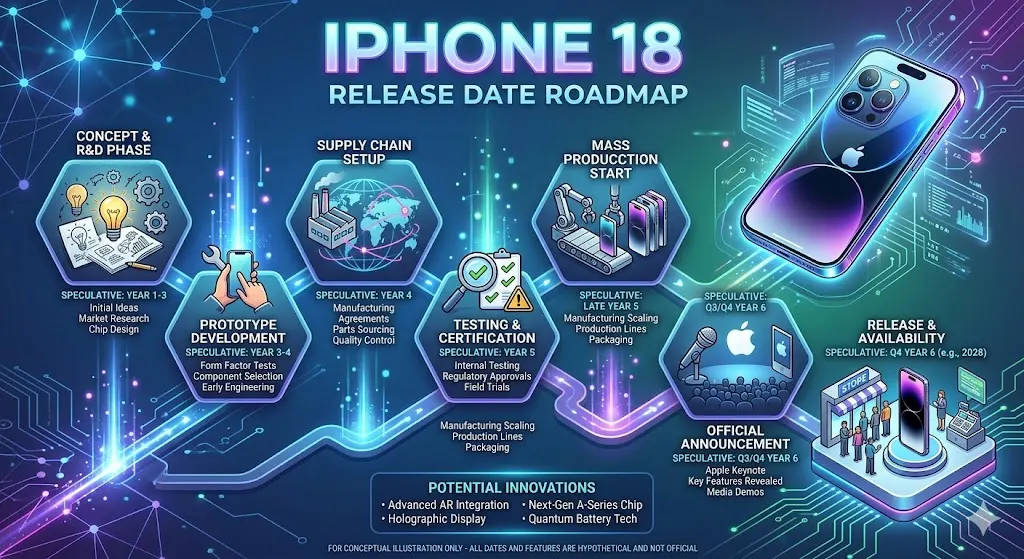
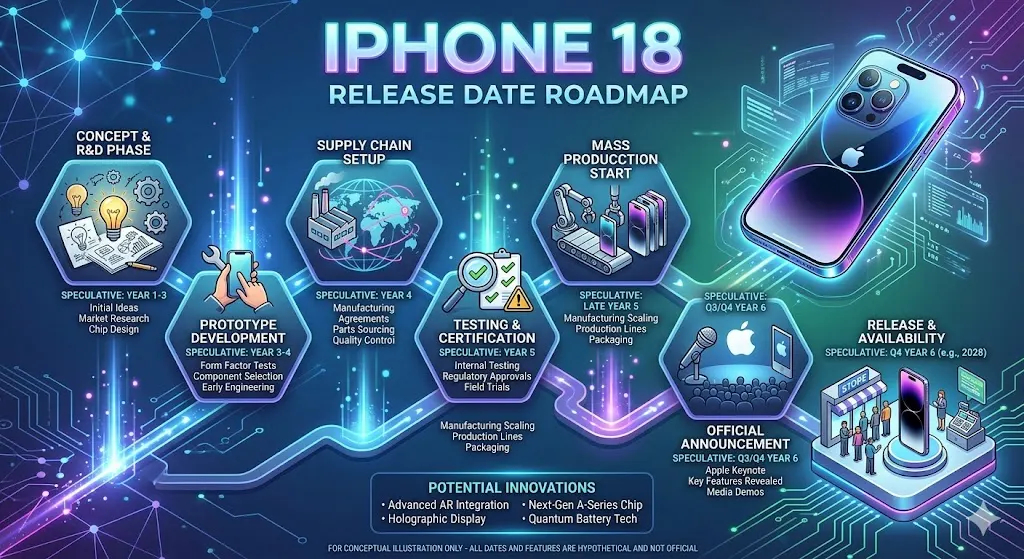
The diagram below maps out the staggered release timeline and key hardware details for the upcoming generation.
Conclusion: A Shift in Mobile Device Lifecycle Management
Ultimately, the strategic shift behind the iphone 18 release date illustrates a mature market, where supply chain efficiency and margin management are just as critical as raw hardware innovation. By dividing its launch cycle into a two-phase roadmap, Apple can safely scale production of advanced 2-nanometer processors, manage global memory constraints, and optimize component costs.
For consumers and enterprise partners, this transition offers a more balanced hardware cycle, ensuring that both premium and value tiers receive dedicated focus and highly optimized hardware. The upcoming hardware generation demonstrates that in a mature mobile industry, success is defined not just by what you launch, but by when and how you deliver it to the market.
We welcome our readers to share their thoughts on this new staggered release strategy in the comments. How does this two-phase timeline affect your upgrade plans?
Frequently Asked Questions (FAQ)
when is iphone 18 release date?
The upcoming release is split into two distinct phases. The premium models (iPhone 18 Pro and Pro Max) and the new folding iPhone Fold are scheduled to launch in September 2026. The standard iPhone 18 and the more affordable iPhone 18e are expected to follow in the spring of 2027, likely around March.
What is the iphone 18 pro max release date?
The iPhone 18 Pro Max is scheduled to launch in mid-September 2026 alongside the smaller Pro model and the folding iPhone Fold. Pre-orders are expected to open immediately following the early September announcement, with devices shipping roughly one week later.
Why is Apple delaying the standard iPhone 18?
The delay is a deliberate strategic move driven by two main factors: cost management and supply chain constraints. By staggering the launch, Apple can extend the commercial window of the iPhone 17 and navigate global high-performance memory shortages. This also allows the manufacturer to lower overall production costs and maximize margins.
What are the key upgrades on the A20 Pro chip?
The A20 Pro chip will be built on TSMC’s next-generation 2-nanometer (N2) process, transitioning from traditional FinFETs to Gate-All-Around (GAA) nanosheets for improved efficiency. It also uses Wafer-Level Multi-Chip Module (WMCM) packaging, integrating the logic board and RAM on a single wafer to reduce latency and boost artificial intelligence processing performance.
How much will the folding iPhone Fold cost?
The new folding model will be positioned as Apple’s most premium device. Base models with 256GB of storage and 12GB of RAM are expected to start at $1,999. Higher-capacity tiers are projected at $2,199 for 512GB and $2,399 for 1TB.
Editorial Note: This comprehensive research report was prepared by the editorial board at Techupdatelab.com to analyze emerging cellular hardware trends. All estimates are based on current supply chain data, chip fabrication schedules, and component pricing indexes as of mid-2026.